Showing posts with label Qld. Show all posts

Thursday, May 9, 2013

Rain forest and reef - Qld

These photos are taken in Queensland, in the rain forest that runs along the coast and a few shots of the coast, which is part of the great barrier reef.

Daintree Rain forest


This beautiful coloured bird is a Cassowary. Thes birds are capable of killing a person, they are endangered,, there are not a lot of them left.


not sure what type of frog this is but it is taken in the Daintree.


Orange-footed Scrub Fowl. these guys make mounds out of leaves and sand to nest in.  Daintree.


This is one of the sepcies of freshwater wish found in the waterways of the rain forest. I think it is called a jungle perch.

Green tree frog, Qld. They range in colour,,some are that really bright green but others like this one are almost a brown colour.

Fungus... Daintree, love the way this round ball had loads of little mushroom shaped others growing off it.

 I dont know what this tree is called, but all the flowers sprouted straight out of the trunk,
Daintree NP.

Dragon fly, Lakefield NP. QLd.

Dew covered butterfly from the Lycaenidae  family Port Douglas, QLd.

Orchard Swallowtail, Daintree, Qld


portrait of an egret. I think this is a cattle egret. Port Douglas, Qld

 This pretty dragonfly is a Graphic flutterer dragonfly. Lakefield NP. QLd


Rainforest flower. Daintreee.


I love this pic of a water lilly because you can see how tiny our native bees are. the large bee is a honey bee, which are of course everywhere, but they are not native to Australia.


This is one of the island on the Great Barrier Reef, This is Lowe Isle.


Underwater scene off Lowe Isles. These corals are Gorgonia fans,, they are actually red when you shine a torch on them. At depth the red light is filtered out by the blue.


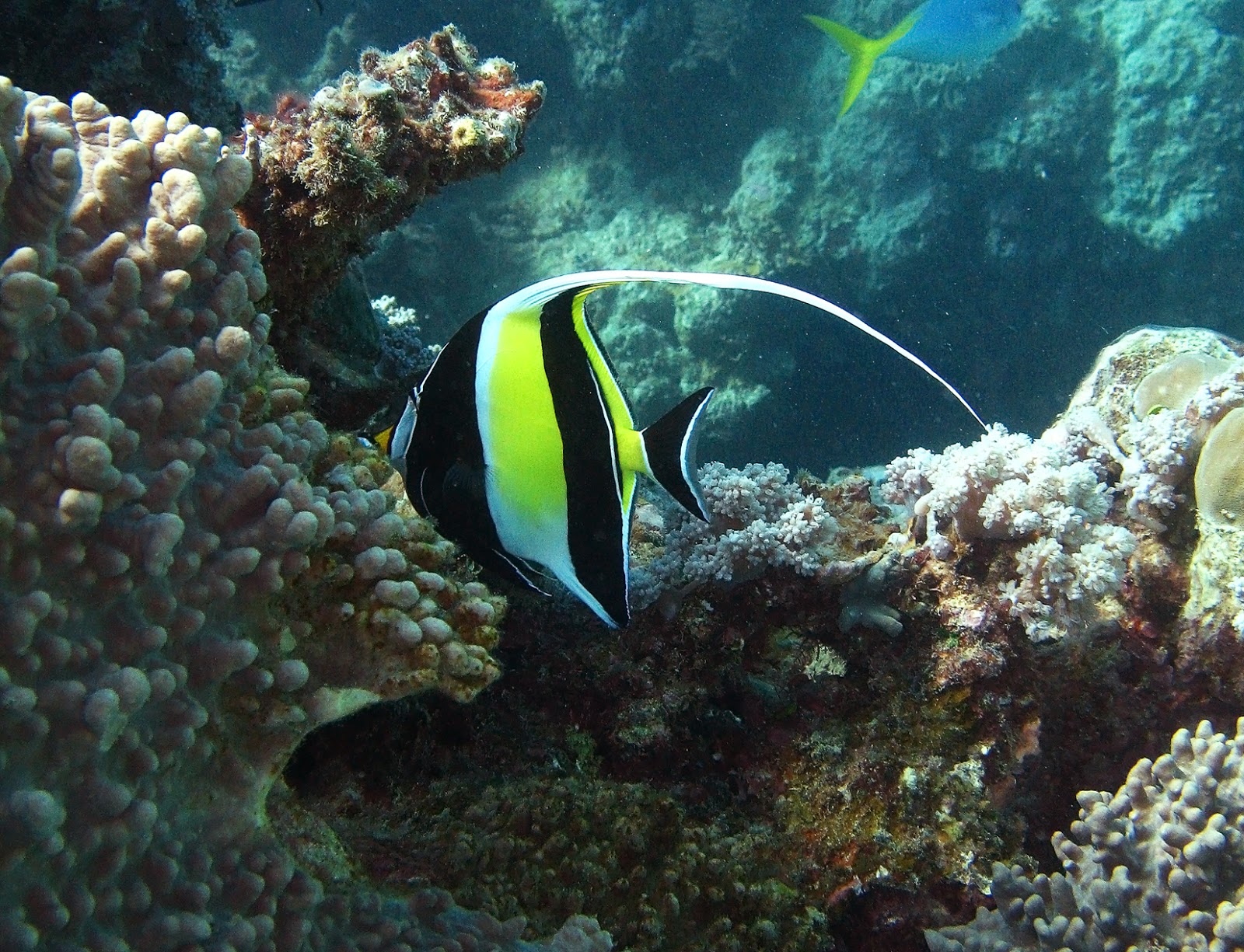
Moorish Idol.


This is a soft coral, not all corals have calcified skeletons.

Monday, December 19, 2011

Queensland - Scenery, September2011

There are some beautiful parts of Queensland, (Qld) where there are very few people. These areas are  oases, some of them with permanent water.
 Taken from a rocky outcrop overlooking the river at Dimantina NP, Qld.

 The view from my campsite at Diamantina NP.
 This is taken at Manton Dam near Mt Isa (large inland mining town). Such a nice place to watch the sun go down. Mt Isa was one of the larger towns we went through. 
 In some parts of Australia there are countless termite mounds. Some are very tall, maybe even 5m tall. These ones are about the height of a person.  In cities the last thing we want is termites eating our homes but out here they perform an important function. They recycle nutrients from the plant matter they feed on. They belong here. This is near Bourketown.

 This spot is near Karumba, which is on the Gulf of Carpentaria.  The sky is a bit smokey as there were a lot of bush fires in the area.
In the foreground I think these are Agile wallabies. On the opposite edge of the waterbody is a feral pig (the black blob). These animals are a real pest to Australian water ways, Our animals dont have hoofs and becasue of this they dont compress the soil as much. Our plants (lots of the grasses)  have evolved in soil that is open. not fouled up and compressed by pigs wallowing in it. All the edge vegetation is destroyed by them. So they have little chance once pigs move in. They are increasing in numbers and seem to be less afraid of people than they use to be, In the two months I was away I saw around 30 of them. Some from much closer than anyone would want to be. I use to think in Australia that we were lucky becasue we dont have bears or lions to worry about when we camp (just deadly snakes and spiders :) ) But the tusks of pigs look huge and because I sneak around taking photos I have surprised a few of them when I have been down wind from them. A family of pigs running by you is terrrifying! worse than any snake or spider.

 This is another shot taken at Karumba. Egrets in the foreground and a flock of darters in the background drying off.  Also below.


 This is the Leichhardt River near Bourktown. There are some safe spots to swim here where there are no crocs. (above and below)

 These are kangaroo tracks of a mother and a joey. I think its really cute. This is from the joey hanging out of the puch as mum leans forward. In many of these places the only tracks you find are from wildlife, no people tracks and no rubbish....so nice.
This is a river near Gregory Downs. I sat here till the sun went down and watch flying foxes fly up the river, using it like it was a highway.


 This is a view over Lawn Hill NP
 I hate heights, and I get awful vertigo but after walking up here in the heat I was determined to look over the edge.This is the gorge that the river runs through at Lawn Hill. It is a permanent waterway.
 On the track walking to the top of the gorge. The tree with the white bark is a Eucalypt (Gum tree) 
 This is a clump of Spinifex grass. Very common in this part of Australia. This is about 5ft wide. This stuff is pricklier than any cactus I ever seen. Every blade of grass is like a needle. If you walk to close and it brushes bear skin it prickles you. Usually when I see it, it is dried off and brown, but it is just as prickly when its green. Lots of little creatures like reptiles and little mammals take refuge in these plants.

 This is the river at the bottom of the gorge.
 I canoed for a way down the river, so very peaceful. There are freshwater crocs in this water and some large turtles that aren't found in many other spots.

The line of blue gums run along the waterway. These lines of trees are a give away to the fact there is water there.
I took the two pics above as we entered Lawn Hill. I love the way trees seem to be able to grow out of solid rock.
 After driving in a general north direction in Qld, this was about as far as you can go (unless you are doing the east coast up to Cape York).  Taken in Karumba, this is the Gulf of Carpentaria. This is where we turned left to go west across to the Northern Territory.

Saturday, June 4, 2011

Heron Island, Great Barrier Reef

In March this year I went on a diving trip to Heron Island on the Great Barrier Reef. It is not very big and is situated on the southern end of the reef. It is probably not much more than a 1km all the way around. I spend most of the time in the water when I'm there however each morning as the sun comes up and every afternoon after the last dive I wander around the island exploring the shore line. Heron Island is a Coral Cay, which means it is made of sand and coral and at its highest point it is only a few metres above sea level.


Pre-dawn on Heron Island


Some parts of the shore line are rock and provide a protective habitat for some creatures like this beautifully marked crab. Shore Crab (Grapsus albolineatus).


Juvenile Silver Gulls(Larus novaehollandiae).


Heron Island got its name from these birds, which were mistakenly called herons by early explorers. They are related to herons but they are actually Reef Egrets(Egretta sacra). There are many of them on the island and unlike other egrets in Australia they come in two colours, white and black.


White Reef egret,


and the dark coloured one.


There are a number of different birds on the island. Some are permanent residents like the Reef Egrets but birds like the one above, a Pacific Golden Plover (Pluvialis fulva)are migratory waders that spend only some of their lives here. There are no cats or foxes either so they are safer here than many places on the mainland.


Although coral and fish are the things most people dive the reef to see, many of the smaller things are really colourful and interesting to look at to. This is a nudibranch, a type of sea slug with visible external gills. There are many differnt types of these and they are some of the prettiest things living on the reef. They get their bright colours from the food they ingest, they graze on a variety of things depending on the species. Some eat sponges, while others coral or algae etc. They can often eat things that that contain toxins which they, instead of excreting, store in their bodies...often evident in the bright colourations that their diet causes. They really stand out but are left alone by most things...their markings acting as a warning, they may also give off scent to that tells other organisms that they are distasteful. It is because of what they eat that they are left alone by most predators and is the reson that they dont need a shell, like many other smaller molluscs.


Corals are a very diverse group. They come in all shapes and colours and many of them are not even hard. Corals generally, are a colonial animal, each individual is a polyp that looks a little bit like a small sea anemone (to which they are closely related - they are both Cnidarians, which also include seajellies and hydroids) The tentacles of these creatures contain stinging cells, some of which affect people while others can't pentrate our skin. Touching corals for this reason is not a good idea. (There other reasons to, like the fact that we can leave a residue from our skin or damage protective coatings that they may have).


Those classified as hard corals excrete calcium carbonate to make a skeleton which is shared by the surrounding polyps. Many of them have a microscopic organism living within them called zooxanthallae which photosynthesizes food for the coral. They (the zooxanthellae)are a type of plant so they need sunlight to do this...for this reason corals live mainly in shallow waters. (often the best diving is in about 12 mtres of water). The other type of coral..soft coral sometimes forms calcium carbonate to, but they are often in the forms of fibres that reinforce structure. When coral feeds ( on the plankton and micro-organisms suspended in the water) the polyps are extended making them look more like flowers than animals. When the polyps are withdrawn the calcified structure is all that is obvious.


This is a Moorish Idol.


Sea turtle resting on the bottom. They visit Heron Island to lay their eggs.


Sponge (Porifera - means pore bearer) comes in many shapes and colours. It is also an animal..very simple single colonial animal, that basically filters micro-organisms out of the water. They do best in areas with some current. They have openings where the water flows in, is flitered of food then flows out. They help keep water clean as they act like filters. There are fossils of sponges that are 1800 million years old....this makes them a life form that evolved very early on in the history of life on earth.


pair of nudibranchs. The feathery bits are their gills. The name, nudibranch means naked gill. above and below.


This is a Black Noddy Tern (Anous minutus). They breed on the island.


Manta Ray . We saw manta rays on most dives this trip. They are really big rays with a span that can be measured in metres. Both of these were at least 2 metres across. They are harmless to people and they are filter feeders feeding on tiny organisms suspended in the water. The extensions at the front helps funnel the water into their mouths.


The orange in this image is sponge. The feathery structures next to it are hydroids, relatives of the anemones. They have stinging cells to immobilise small prey (The stinging cells are a charactersitic of all the Cnidarians)


Sometimes when swimming through gaps or under overhangs you come across a school of fish. As they swim past every single eye looks at you and they all have they same expression, it is almost surrealistic and every time it happens it is as exciting as the first. These fish are Hussar.


During the summer months and a little before and after sea turtles come to Heron Island to lay their eggs. The hatchlings often emerge on mass from the nest (a hole in the sand where the eggs were buried) at night time. (it gives them protection from many birds) but some times odd ones emerge in daylight hours and make their way to the water. If they aren't eaten by birds first, they have to swim the guantlet....the sharks know that there are hatchlings at this time of year so they hang in the shallows and wait for them arrive, picking off most of them before they get to come up for their third breath of air. Turtles can lay roughly 60 - 160 eggs each year that they reproduce. They live along time, it is estimated that they may not reach sexual maturity till they are at least 25 years old. They may live around 80 years but figures are estimates because no one really knows. In their lifetime out of all the eggs they produce only 2 need to make it to adulthood and reproduce to keep the numbers up. (Thats the theory anyway...its one very good reason why these animals need protecting....from people) In the early days of Heron Island's history the island was used for making turtle soup. Now there is a turtle research station there.


This is a Gorgonia fan...a type of coral.


When we think of worms we generally dosn't envisage creatures that we would think of as attractive but marine flatworms can be really eye catching like this one pictured above. Some of these worms can swim by undulating their bodies and they look like a ribbon fluttering in the breeze. This one was about 6cm long.


This is a hard coral.


Hard coral. Corals are hard to identify to species level because colonies of the same species can take on very different forms according to where they are growing.


This a coral with all its polyps exposed for feeding. double click on this to have a closer look.


In this coral head there are other creatures living in holes, they are tiny hermit crabs...less than 1 cm across. Most hermit crabs live in shells that they claim, these little crabs spend their hole..oops, whole life living in the same coral head. I have not found these crabs very often, it is a shame that when you are doing a 'drift dive' you cant stop for too long at any one place to have a really good look.


Hard coral.


This is another type of colonial animal...not as simple as a sponge however. The mass above is actually a group of colonial sea-squirts...or ascidians. Their lives are fairly simple, another creature that just sucks water in, filters it of food and then squirts it out. each individual generally has an inlet syphon and an outlet syphon. Sometimes though in colonies they may share an outlet. When these organisms are in the early stages of their lives they are free swimming larvae for a number of hours before they settle in a suitable spot. The really intersting thing about these creatures is that they have a very rudimentry spinal chord..or notochord! This is the first of what we see of a backbone. All creatures with back bones, including us, evolved from this creatures ancient ancestor...the beginnings of the tree of chordates ..or back boned creatures.


This is one of my favourite fish..a Bat fish. They are the size of a dinner plate and fairly slow moving, which makes them a good candidate for photos with simple digital cameras that have delay after you press the shutter!