Showing posts with label australian marine life. Show all posts

Saturday, May 28, 2011

Giant Cuttlefish


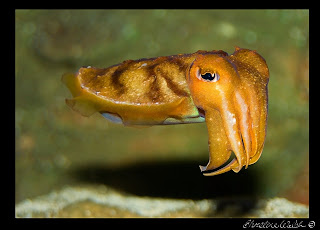
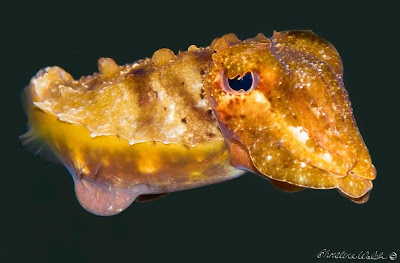
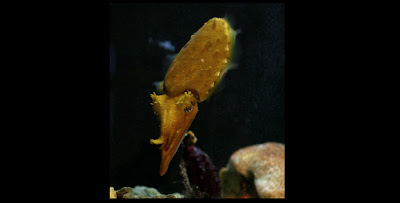
This is a juvenile Giant Cuttlefish found along Australia's southern coast.  The photos were taken at the Marine Discovery Centre in Queenscliff, Victoria.
They are fascinating creatures to watch. Not only can they change the colour pattern of the skin but also its texture. As adults they can reach a metre in length and live for about 2 years. It has been recently discovered that they aggregate in very large numbers to breed in the Spencer Gulf in South Australia. The one in the picture is only about 15cm long.


These two photos were taken as it was stalking a fish. They use two specialised tentacles to strike out at their prey after they have stealthfully floated up close to it. On the underside of its body you can see two fins or rudders, which are made out of soft tissue only and it is able flatten them or make them more prominant at will.


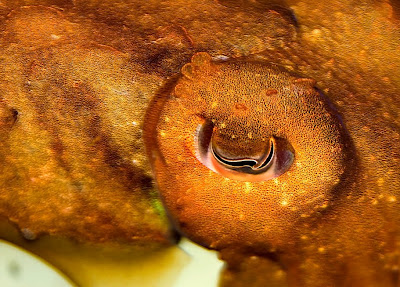
This is a close up picture of the eye. The spots on the skin are called chromataphores and they are like little sacks of pigment, by flattening out or squeezing tight these little sacks they are able to change their skin colour and pattern at will. It can use this as a means of camouflage; to make themselves blend in with their surroundings and also to communicate with other cuttlles.


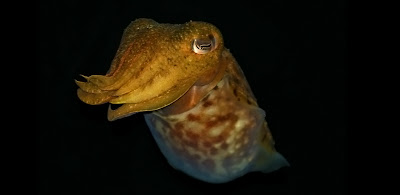
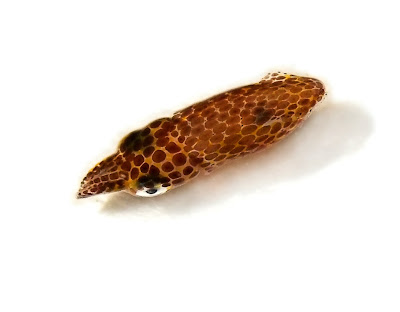
This last photo is of a juvenile Southern Pygmy squid (a close relative to cuttlefish), only a day after it hatched. It is only 1 cm long and this is a picture showing it starting to display different patterns with its chromataphores.....I call it "First Words".


Monday, August 31, 2009

Marine Biology Boat Trip - Port Phillip Bay, Vic.

The Port Phillip Bay on Victoria's south coast is a pleasant place to spend a few hours looking at some of the interesting marine life we have here. Any day on a boat ride you might see seals, dolphins, a number of different water birds and if you were really lucky maybe even a whale. I had the opportunity to go out on one of these trips last week and take photos of some of the things that are common - and some things that are not so common.


These two photos are of pied cormorants taken near a spot known as the Chinamans Cap which is a place where bachelor Australian Fur-seals hang out (shown in the following pics).


The next three photos are of the seals. They are interesting to watch and there are more seals than there is room on this platform so there is a continual jostle for the best spots to sun yourself.


Aside from birds and mammals there are representatives from a number of different phylums (animal groups) in the bay. To see what some of them are we collected a few buckets of seaweed from about 12m of water and looked through it closely. It takes a few moments but you start to see all sorts of things moving in amongst the weed. The weed is put in trays with water so that creatures can be put back in the water after we inspect what is living there.
So what did we find?
All the animals with back bones are chordates and this includes all the birds, marine mammals, fish and the most simple of all the chordates - the sea-squirts (ascidians). Sea-squirts can be hard to see as an animal - especially one that is a chordate. Something similar to this is what all back boned creatures evolved from. The sea squirt only has a notochord(primitive backbone) when it is in larval form. The photo below is an ascidian called a Sea Tulip-it is shown about actual size but this is a juvenile. They have a fairly simple body plan - one opening that is an inlet for water and and outlet to squirt water out after it filters food from it. They live attached to seaweeds or rock.


Short -snout seahorse. Seahorses are fishes that belong to a family called Syngnathidae.

Another marine phylum known as the Echinoderms (meaning spiny skin) is represented by a few different types of related animals. Sea-stars, sea-urchins, sea-cucumbers, are all in the group. This one in the pic below is an Eleven-armed sea-star (juvenile). Echinoderms are the only other group apart from vertebrates that have an internal calcareous skeleton. They have a water vascular system and many can regrow a lost arm ( even the arm that is removed will grow into a new individual as well if it isn't too damaged). This one is growing new arms - eventually they will all be even in size. The spines on sea stars are often not sharp at all but like like little projections all over the body.
Sea-urchins are ball shaped creatures that are mainly hollow inside unless they are in reproductive mode and then they are filled with eggs or sperm. They have spines to protect themselves.


Molluscs form another phylum. (molluscs include octopus, squid, cuttlefish, seaslugs, bivalves and gastropods) These bivalves above live attached to seaweeds and they are in the same family as Pearl Oysters. The thing I find interesting about this photo is that these shells are a micro-habitat. There are quite a few different species in this picture: 5 different types of algae, a sea-anemone, a gastropod (seasnail), bivalves and the little white spots which look like the start of sponge colony (phylum - Porifera). Many of the creatures that live in the bay have cryptic lifestyles and are hard to spot.


Gastropods (sea-snails)
1.


2. Gastropod - Pheasant Snail.


3. Sea Hare-Aplysia parvula. These creatures feed on seaweed. This species takes on the colour of the seaweed that it feeds on. It appears to have been feeding on red seaweed. All the members of this family are capable of releasing purple ink if they feel threatened. The dark colouration is a feature of this species that makes it easy to identify.
4. Gastropod- The thing I like about this photo is they way you can see not only its tiny eye but also tentacles from all around its body.


5. Gastropod - This is an Anemone Cone. These are some of the more evolved gastropods. They are carnivores and from the proboscis (snout) protruding from the front of they creature they are able to shoot a poisonous harpoon which paralyses their prey. This species feeds on bristle worms. Some species of this family are extremely dangerous and have been known to kill people. This southern variety is not considered to be extremely dangerous but handling them is probably not a good idea. An attack by one of these may not be life threatening but it apparently feels a bit like a bee sting.

6. Gastropod


Many molluscs lay their eggs on the weed. These ones may be from a Sea-hare.

  Phylum - Echinoderms.
1. This creature is a sea cucumber. The picture is a little larger than actual size. They are related to sea-stars and urchins. They have a mouth one end and an anus at the other. Many of them take in large quantities of sand and eat the algae off it so that their waste looks like something out of a toothpaste tube except that it is sand paste.

This is a sea-star - part of a group called Feather-stars. They attach themselves to weed or rock with the smaller leg like tentacles while the feathery arms sit in the current catching tiny food particles. The next few photos are also of feather stars.


The next two photos are bristle stars. They are the greyhounds of the seastar world in that they can actually move quite quickly.


Phylum - Crustaceans
The next few photos of crustaceans. Crabs Crayfish and Prawns are the well known members of this group but there are many other lesser known creatures like amphipods and isopods.

These two photos are two different species of hermit crabs. Both are in shells about 10mm in size.


These next three photos are of the same species but all with slightly different colouration. They are tiny flat shelled crabs with ornamentation on their back that looks like encrusting growth - It is the near symmetry that gives it away to our eye but in amongst the weed or debris this crab would be hard to spot. Crabs are able to regrow lost legs but only when they moult and get their new shell. Sometimes they don't form completely or are a different colour. If you look closely at the next three pics you can see some have lost legs and some have legs that have grown back.


This is a type of marine slater, an isopod. They have a body that is flattened and they are much more wide than thick. Others in this family are not so colourful.


This is also an isopod sometimes called a sea centipede.


This photo is of an amphipod - similar to an isopod except that their body is compressed sideways.


This pic is also of an amphipod sometimes called a skeleton shrimp. This was taken on a previous trip on the bay but I added it here as I think it is rather bizzare and interesting. These are usually on weed and have evolved to suit where they live.


Phylum - Cnidarians - Sea anemones
Sea-anemones, corals and sea-jellies are in this group. We found a 3 different anemones amongst the weed.
This photo and the two below shows somthing I find really amazing. Some anemones reproduce sexually by releasing eggs and sperm into the water and are fertilised externally. Some form little minature clones of themselves on the surface of their body and some are able to split into two. This is none of those. It is one of a few anemones that give birth to live young. If you look at the mouth you can see the little round individuals waiting to be ejected. As this was moved many little creatures filled the water around the parent. In the last photo if you look carefully you can see some of the little baby ones about 20 minutes after they were "born". If your wondering how this can be its like this: early in the reproductive season the parent forms eggs (it is a functioning female) once the eggs are formed it then does a sex change and makes sperm which fertilise the eggs which then develop inside the parent anemone. When they are sufficiently developed they are expelled and then find their own place to settle and grow. The common Waratah anemone, found on rocky shores also reproduces like this. I havnt been able to work out exactly what type of anemone this is yet.


This next anemone is called a walking anemone as it doesnt stay attached to the substrate like many other anemones. All anemones have stinging cells (nematocysts) in their tentacles that they use for catching food. These anemones will eat fish larger than themselves, catching them with their tentacles after the stinging cells have paralised it, taking many hours to eat the whole thing. The other anemone we saw is the Orange and White anemone which is on the bivlaves in the beginning of the post.


Ascidians (sea-squirts)
The creatures in the next two photos are related to the Sea tulip at the begining of this post except that these ones are colonial. Eack creature is still a simple animal with an inlet and outlet valve but they are joined together with none living as individuals. Each individual has its own inlet but they share a common waste outlet with those nearby. They are soft jelly like masses and I find these creatures really beautiful. Remember these are very similar to the ancestors of all backboned creatures!


Tuesday, August 25, 2009

Molluscs

Molluscs are a diverse group of animals which includes octopus, squid, cuttlefish as well as snails, bivalves and chitons. They are important food animals world wide and some of them for eg. oysters are farmed for eating and also for the production of pearls.


Octopus have been found to be extremely clever- for an invertebrate, and can find their way through complex mazes and they constantly surprise scientists who study them. Octopus, squid and cuttlefish can all change their skin colour and texture which helps them hide in plain view from predators (and their prey) and to communicate with other members of their species.


Generally speaking you would expect to find octopus in water but in the above two images it shows one making its way across a rock shelf from a rock pool (that it was stranded in at low tide) to the ocean 25 m or so away. When I moved in close to photograph it it squirted me three times as I moved around it. It hit me with a jet of water and its aim was spot on no matter if I was in front or behind it. The image was taken at Point Sampson in WA.


At the other end of the scale we have the bivalves like this scallop and gastropods(snails). Scallops live on the sea floor and are filter feeders-they feed of tiny microorganisms. The first time I went diving over a scallop bed I was amazed to see the way move. They snap their shells closed and in effect it works like jet propulsion and moves them about .5m and they can repeat it a number of times so they move some distance. Why do they need to move like this? So they can escape the creature that commonly preys on them - seastars. Over long periods of time they have evolved senses to let them know when their predators are near by. This type of scallop is a popular seafood and fished commercially.


The blue dots around the edge of the shell are eyes. Their eyes don't work anywhere near as well as ours but they certainly have a lot of them!


This is a cone shell. There are many different species of cone shells, many of them have distinctive patterns especially those of tropical regions. This one is from Victorian waters.
This family has a surprising method of self defence. They are able to release projectile darts at anything that handles it or attacks it. The darts have barbs on them and carry toxins. They are normally used to disable its prey. Some are much more dangerous than others. Some tropical species have been responsible for deaths of people. This is a Victorian species and is not considered to be extremely dangerous but it is best not to handle any species of cone shell. These creatures feed at night time so it is easy to avoid them.


This is a Pale-headed octopus, they are found in Victorian waters.


Sea snails can be herbivores(feed on algae and plant matter) or carnivores that feed on live prey or as scavengers. Many sea snails are simple algal grazers and are preyed on by other snails that have developed ways of either drilling holes into other snails shells or by forcing open the tiny door(operculum) that many of them have at their opening.


Although no cephalopods(octopus,squid and cuttlefish) live in fresh water there are a number of bivalves and snails that do. Snails have also become land dwellers and world wide there are hundreds of species that have done so.


Australia is home to a couple of species of octopus that are very tiny and very deadly. It is the Blue-ringed octopus. The one in the photo is from Victoria's temperate water and there is also another similar species which lives in the tropics. They are tiny-the size of a golf ball and their bite is painless but they deliver a powerful neurotoxin that can kill in minutes. They can be found in rock pools and may hide in anything that they can fit in - such as shells. As a general rule especially in Australian waters- NEVER put you fingers anywhere where you cant see them and be careful of the things you do pick up to examine. CPR done effectively will keep a victim alive until an ambulance arrives.


This is a cuttlefish, closely related to the octopus but these creatures have an internal shell, the "cuttlebone" which are often found washed up on beaches as they float. They have eight shorter tentacles and two long ones. In the photo below the cuttle is stalking a ghost shrimp, once it gets withing range of its tentacles its lashes out very quickly at its prey retrieving to its' mouth almost too quickly to see. Note the finger like projections above the eyes.


This picture and the two below are of a nudibranch (a type of sea slug). The branch like structure on its back are actually gills and the name nudibranch literally means naked gill. They are often brightly coloured which warns would be predators that they are distasteful or even toxic. Many of them feed on sponges which often contain chemicals or toxins that they then use for their own defence, and these substances help give them the bright colours and patterns. This one is found in Victorian waters, but most members of this family live in tropical water.


This is a nudibranch from tropical waters around Low Isles in Qld.


Occasionally clusters of eggs like these are washed up on the beach with seaweed. It is an egg mass laid by multiple squid. Squid are similar to cuttle fish but they have no "cuttlebone". The tend to live in open ocean and move quickly.The picture below is of a juvenile squid that hatches from these eggs.


The shells in this picture are neither snails or bivalves. In the middle the creature that looks kind of like a slater is a chiton, a mollusc with eight valves (or plates) They suck firmly onto rocks and feed on encrusting growths(both plant and animal). They are more active, albeit very slowly, at night and they tend to hide under rocks and in crevices. If caught out in the open fish like wrasse will soon pick them off and eat them. Some species have light sensitive spots so they can tell when its night and day. The other shells in the picture are not molluscs at all, they are crustaceans-barnacles and are related to crabs.


This type of bivalve is only found in the tropics(above and below). It is a giant clam and they can grow to be some of the largest shells. These two are at Low Isles. The top one is about 600mm across and the bottom one is much smaller and is a Burrowing clam around 200mm. The largest species in this family may be a metre wide.


Below are some of the common seasnails in Victoria.

This is a pheasant snail, it is popular with collectors because of its pretty markings. Urqharts Bluff, Vic.


Sea snail, Urqharts Bluff, Vic.


Sea snail, Queenscliff, Vic.


These are cowrie shells found along Victorias coast.


Sea snails on Neptunes Necklance, Anglesea, Vic.


These are turbos or warreners, they are common along Victorias rocky shores. These are an edible species and in the past were a food source for aboriginal people of the area.


There are many types of sea snail each with its own particular preferences for food and where they live. Those creatures that are intertidal have to contend with very varied conditions especially on the southern coast. They need to be able to cope with being in water and out of water for extended periods, they need to be able to handle both very hot and cold conditons, drying wind, and even fresh water when it rains and pools around them.


Nerites.


Limpet shells, Vic. Limpets are well designed for intertidal areas. Their muscular foot acts like a really strong suction cup and holds them to the rocks which they live on and their conical shape allows even really rough waves to wash over them without dislodging them.


Depressions in rocks become micro habitat areas for these creatures to congregate. It stays more moist and is out of the way of drying wind.


These are Blue Periwinkles, they live higher up the beach than most other seanails and some even live up to 10m further up the beach than high tide mark.

This is a selection of shells from Urqharts Bluff, Vic. a rocky area of a surf beach. It is quite a diverse collection and were all in the bottom of a small rock pool. The black surface they are sitting on is made up of mussels. Some areas the rock is not visible at all - a carpet of small mussels covers them.


These shells are from a sandy/muddy area in Swan Bay where there is no surf and is inside Port Phillip Bay. Vic.