Showing posts with label diving. Show all posts

Thursday, May 9, 2013

Rain forest and reef - Qld

These photos are taken in Queensland, in the rain forest that runs along the coast and a few shots of the coast, which is part of the great barrier reef.

Daintree Rain forest


This beautiful coloured bird is a Cassowary. Thes birds are capable of killing a person, they are endangered,, there are not a lot of them left.


not sure what type of frog this is but it is taken in the Daintree.


Orange-footed Scrub Fowl. these guys make mounds out of leaves and sand to nest in.  Daintree.


This is one of the sepcies of freshwater wish found in the waterways of the rain forest. I think it is called a jungle perch.

Green tree frog, Qld. They range in colour,,some are that really bright green but others like this one are almost a brown colour.

Fungus... Daintree, love the way this round ball had loads of little mushroom shaped others growing off it.

 I dont know what this tree is called, but all the flowers sprouted straight out of the trunk,
Daintree NP.

Dragon fly, Lakefield NP. QLd.

Dew covered butterfly from the Lycaenidae  family Port Douglas, QLd.

Orchard Swallowtail, Daintree, Qld


portrait of an egret. I think this is a cattle egret. Port Douglas, Qld

 This pretty dragonfly is a Graphic flutterer dragonfly. Lakefield NP. QLd


Rainforest flower. Daintreee.


I love this pic of a water lilly because you can see how tiny our native bees are. the large bee is a honey bee, which are of course everywhere, but they are not native to Australia.


This is one of the island on the Great Barrier Reef, This is Lowe Isle.


Underwater scene off Lowe Isles. These corals are Gorgonia fans,, they are actually red when you shine a torch on them. At depth the red light is filtered out by the blue.


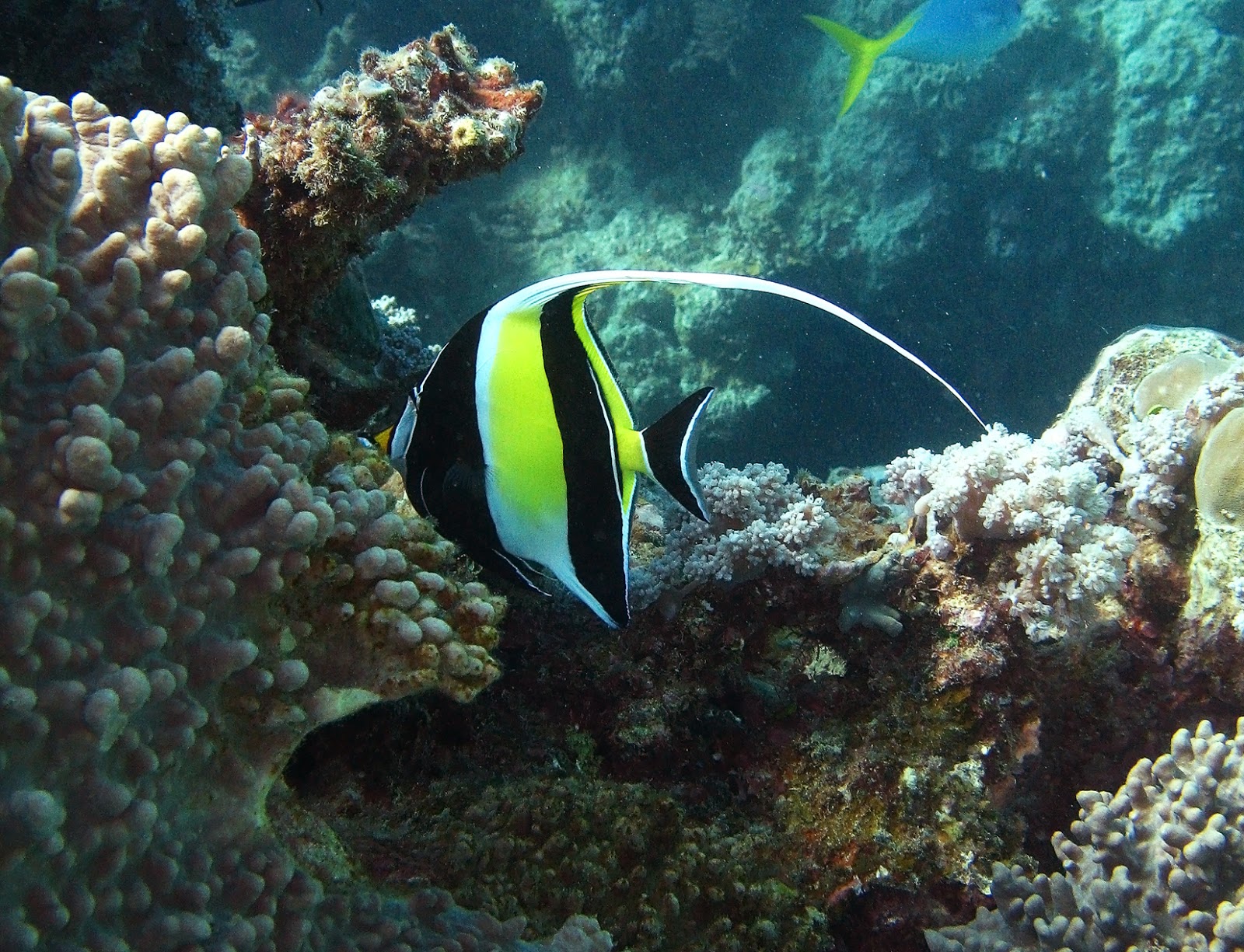
Moorish Idol.


This is a soft coral, not all corals have calcified skeletons.

Sunday, November 27, 2011

Tropical Wetlands- below the surface - Northern Territory

In the Northern Territory there are a few springs, some of them thermal, which you can swim in safely without worrying about Esturine crocodiles. I took my mask and snorkel in to see if there were any fish. Swimming in these pools is like being in an aquarium. The water is so comfortable and clean and it is extremely beautiful. I was surprised by the amount of different types of fishes. These are pictures of what I found.

Chris, Lorella Springs NT


underwater scene, Bitter Springs, Mataranka

Rainbow Fish

This fish is called a scat.


Berry Springs, near Darwin. This school of herring like fish were about 20ft deep. They just seemed to hang in open water.


Long Tom. Bitter Springs, Mataranka, NT


Water Lilly, Berry Springs


and this is what water lillies look like underneath the water.


Waterplant. Lorrella Springs. NT


Freshwater crocodiles are found in these springs but generally they leave people alone (unlike their larger cousins). I didnt see any while I was snorkelling.


Rainbow fish, Lorella Springs.


Rainbow Fish. There a number of different species of Rainbow fish.


This is a freshwater saw shark. They are endangered. They live in the same waterways as the very dangerous Esturine crocodiles. I took this photo at  an aquarium at the Territory wildlife Park, NT.


Eel-finned catfish, Berry Springs.


This pair of damselflies are laying eggs on the vegetation under the water.The male is the blue one. Often in dragonflies and damselflies the males and females differ in colour. I dont often get to see this at eye level.


Berry Springs, NT.

Algae, the simplest of plants has no structure to it and quivers slowly as the water flows over it. take it out of the water and it is nothing but slimy substance without much form. Seeing this was every bit as beautiful as any scene in the sea.


water plants at Lorella Springs. NT

I took this photo from a boat. Throughout ther water ways in Australia's tropics there is a danger of being attacked by Esturine crocodiles. They can be really hard to see as they blend in so well to their environment. Oddly some water birds dont worry about attacks from crocs. Egrets stalk fish quite happily near them and they aren't  attacked.


This is a barramundi, a favourite eating fish in the NT. This is a small one which means its male, they change their sex to female when they are about eight years old. They are sexually mature at 4. So four years as a male and then the rest of their lives they are female.


This is an archer fish, so called because they spit at insects flying above the water and as they fall onto the surface of the water they are eaten.


Some of the springs have really large schools of thes rainbow fish, the biggest of which is about 100mm or so.

Tuesday, June 2, 2009

Sea Turtles

This hatchling has made it safely to the waters edge without being attacked by a gull or a reef egret. Even so its troubles are just beginning- it now has to dodge multiple predators, including a school of black-tipped reef sharks that patrol the shore line waiting for them to enter the water. Only when many of these little turtles reach the water at the same time do they have much chance in making it into the open oceans. Turtles are a fairly common sight when we dive but we only ever see full grown or nearly full growns ones, never smaller ones.


Sea turtles come ashore to lay their egss in the sand. They usually do it at night time but this one must have started late. While she is busy covering her eggs she inadvertantly uncovers some turtle hatchlings that were layed earlier in the season. This is a Green turtle. This species is the most popular for eating in other parts of the world. This is at Heron Island where they are protected...now. Before Heron Island was a national park, in its early days turtles were hunted to make soup.


A Hawksbill Turtle taking time out for a rest on the bottom. These turtle are found in warm temperate and tropical seas the world over. This one was photographed at Heron Island in Qld where they are classed as vunerable. Worldwide they are considered to be critically endangered. They feed mainly on sponges but will aslo eat soft corals, sea grass and molluscs. In other parts of the world they are exploited for their shell.


A school of Strawberry Hussar swim past me and as they do everyone of them checks me out. Their movement is so well coordinated that as I swim between them they part, keeping about a metre away all the time and keeping the distance of a few cm between each other. They all change direction almost simultanously and they never even come close to bumping into one another. It is fascinating to watch the way these groups move as if aware of the position of every other individual around them. If we could learn to do this as well as them, many road accidents could be a avoided.
Semi-circle Angel Fish, Heron Island.
This is a photo of me and my husband/dive buddy, Dale taken a few years ago when we last visited Heron Island.